

The Balvenie is one of those Speyside names every Scotch drinker should taste at least once — which is exactly why we have slipped several of its expressions into the whisky tasting boxes we send our customers.
Founded in 1893, The Balvenie has spent well over a century refining its craft without ever standing still, and the drams it produces today still feel as fresh as ever.
In this article, we trace a little of the brand’s history and explain what earned it such a strong reputation.
We also walk through its expressions, including the ones we featured in past Whisky Tasting Boxes.
Table of Contents – Sip this article!

The Balvenie Doublewood 12-Year-Old, the Doublewood 17-Year-Old and the Doublewood Caribbean Cask 14-Year-Old were all expressions we’ve sent to our clients in the past
The Balvenie Whisky – Before Bottling, the History
The Balvenie officially began production on the 1st of May, 1893, in Dufftown, in Scotland’s Speyside region, under the hand of William Grant. From the very start, the distillery set out to produce outstanding, innovative Scotch Whisky, and it has stayed true to that purpose ever since.
True to what the brand calls its Five Rare Crafts, the whisky made at The Balvenie’s distillery is among the most handcrafted of single malt scotch whiskies. That alone goes a long way toward explaining why the brand creates such distinctive drams, prized by connoisseurs and newcomers alike.
Where is The Balvenie Made?
The Balvenie Single Malt Scotch Whisky is made in Dufftown, a Scottish town in Speyside, sitting between Aberdeenshire and the Highlands with easy access to the shore and to fresh water sources.
Dufftown produces more whisky than anywhere else in Scotland, and it is also home to The Balvenie Castle, a medieval building dating back to the 13th century.

How to Pronounce The Balvenie
Plenty of Scotch whisky names are tricky to pronounce, but The Balvenie isn’t one of them. Phonetically, it’s said bal·veh·nee, though some connoisseurs say bol-vainny instead — neither way is wrong.
The name comes from Balvenie Castle and means “Village of Luck”.
Producing The Balvenie Whisky
The Balvenie has been made for over 200 years using what the brand calls its “Five Rare Crafts”, the stages William Grant put in place and that are, remarkably, still followed today. That blend of centuries of experience and ongoing innovation is what earned this Speyside brand the title “the most hand-crafted of single malts”.
So what exactly are these Five Rare Crafts that make The Balvenie Whisky so special?
It all starts with the barley
The key cereal used to make the whisky is grown by The Balvenie exclusively for its own production, on a thousand-acre farm where the only machine involved is a combine harvester. Everything else is handcrafted, and that is what gives the whisky its unique character and flavour profile.

Then come the floor maltings
Only a handful of working floor maltings are left in all of Scotland, and The Balvenie owns one of them. On these wide malting floors, the barley is spread out to germinate, and because there is so much room, the “malt men” can turn it by hand right up until it goes into the kiln.
In the kiln, a touch of peat is added, giving The Balvenie whisky an extra layer of complexity.
Next, the copper stills
How the whisky is distilled matters enormously, shaping both its flavour and its mouthfeel. The Balvenie’s copper stills have barely changed since the distillery was founded: they have a distinctive boil ball — the “Balvenie Ball” — and a swan’s neck shape that shows through in every bottling.
That ball-shaped still lets the vapours mix thoroughly, which is where a lot of the whisky’s fruity, floral character comes from.
The fourth craft lies in the casks
As any whisky connoisseur knows, most of a whisky’s flavour comes from its casks and the time spent maturing in them — and it is here that The Balvenie invests the most.
To begin with, the brand lightly toasts its casks so the wood sugars caramelise and the pores of the wood open up.

And finally, the Malt Master
The last — and arguably the most important — of these Rare Crafts is the Malt Master. David Stewart has held that role across the whole of the Scotch whisky industry and has personally evaluated over 400,000 casks of The Balvenie.
He is the one who decides whether each cask is ready to be bottled at 12 years old, or should keep ageing for 21, 30, or even more years.
David Stewart was also a true pioneer of the maturation process: he is the one who came up with the “wood finishing” concept in the first place.
These days, he is passing that knowledge on to Kelsey, who is now responsible for keeping consistency across barrels of the same expression and making sure the whisky ages exactly as the brand intends.
The Balvenie Whisky Flavour Profile and Expressions
Among The Balvenie’s single malt range are expressions that have picked up multiple awards over the years. Some, like the Doublewood 12-Year-Old, are already Scotch classics; others, like the 14-Year-Old Caribbean Cask, are better described as examples of innovation within the whisky world.
In our Whisky Tasting Box, we have sent our customers both of those expressions, as well as two that are no longer in the brand’s core range: the 10-Year-Old Founder’s Reserve and the Doublewood 17-Year-Old.

What Does The Balvenie Taste Like?
It is hard to pin down a single flavour profile that holds across the whole range, but a few traits do run through most of The Balvenie’s expressions.
Given that this is a scotch whisky produced in Speyside’s region, expect a profile that leans smooth and fruity, with floral hints that owe as much to the barley used as to the distillation process itself.
The Balvenie isn’t generally known as a peated or smoky whisky, although the brand does have a whole line of peated scotch whisky, and a few of its expressions carry a light touch of smoke.
Overall, expect a honeyed background note, a result of the light toasting given to the barrels, and plenty of complexity and richness, since most expressions spend time in two or more different types of cask.
The Balvenie Single Malt Scotch Whisky Expressions
The expressions below are the ones we have actually sent to our customers as part of their whisky subscription.
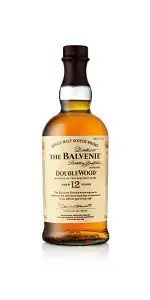
The Balvenie Doublewood 12-Year-Old Single Malt Scotch Whisky
The Balvenie Doublewood 12-Year-Old was the first Scotch whisky ever released using a wood-finishing method of maturation. Launched in 1993, it remains a classic among Scotch connoisseurs to this day.
The spirit spends 12 years maturing in ex-Bourbon casks, then finishes for nine months in ex-Oloroso sherry casks.
The ex-bourbon maturation gives it a delicate character, while the Oloroso sherry casks add richness and sweet fruit notes, with vanilla and honey coming through as well.
The finish is long and smooth, with hints of cinnamon.
The Balvenie Doublewood Caribbean Cask 14-Year-Old Single Malt Scotch Whisky
This expression goes through a careful hand-selection process. The Doublewood Caribbean Cask 14-Year-Old matures mostly in American oak casks, but its finish has a twist: the Malt Master fills American oak casks with hand-selected rum, and those are the casks used to finish this whisky.
That combination gives it The Balvenie’s standard flavour profile layered with the fresh fruit notes so typical of rum.
On the nose, expect sweet, fruity aromas; on the palate, notes of toffee, vanilla, fresh fruit and oak.
The Balvenie Single Barrel 15-Year-Old Single Malt Scotch Whisky
This is another classic from The Balvenie line. Being a Single Barrel release means it only ever exists in a limited number of bottles, and our customers were lucky enough to receive a miniature of it.
This dram matures for 15 years in a single European Sherry Oak barrel, with around 800 bottles released from each one.
As singular as it is, the Single Barrel 15-Year-Old carries dried fruit and nut aromas in the background. On the palate, expect a round mouthfeel with sweet oak, cinnamon and sherry notes.
If you would like to taste new drams like these every month, take a look at our whisky subscription box.